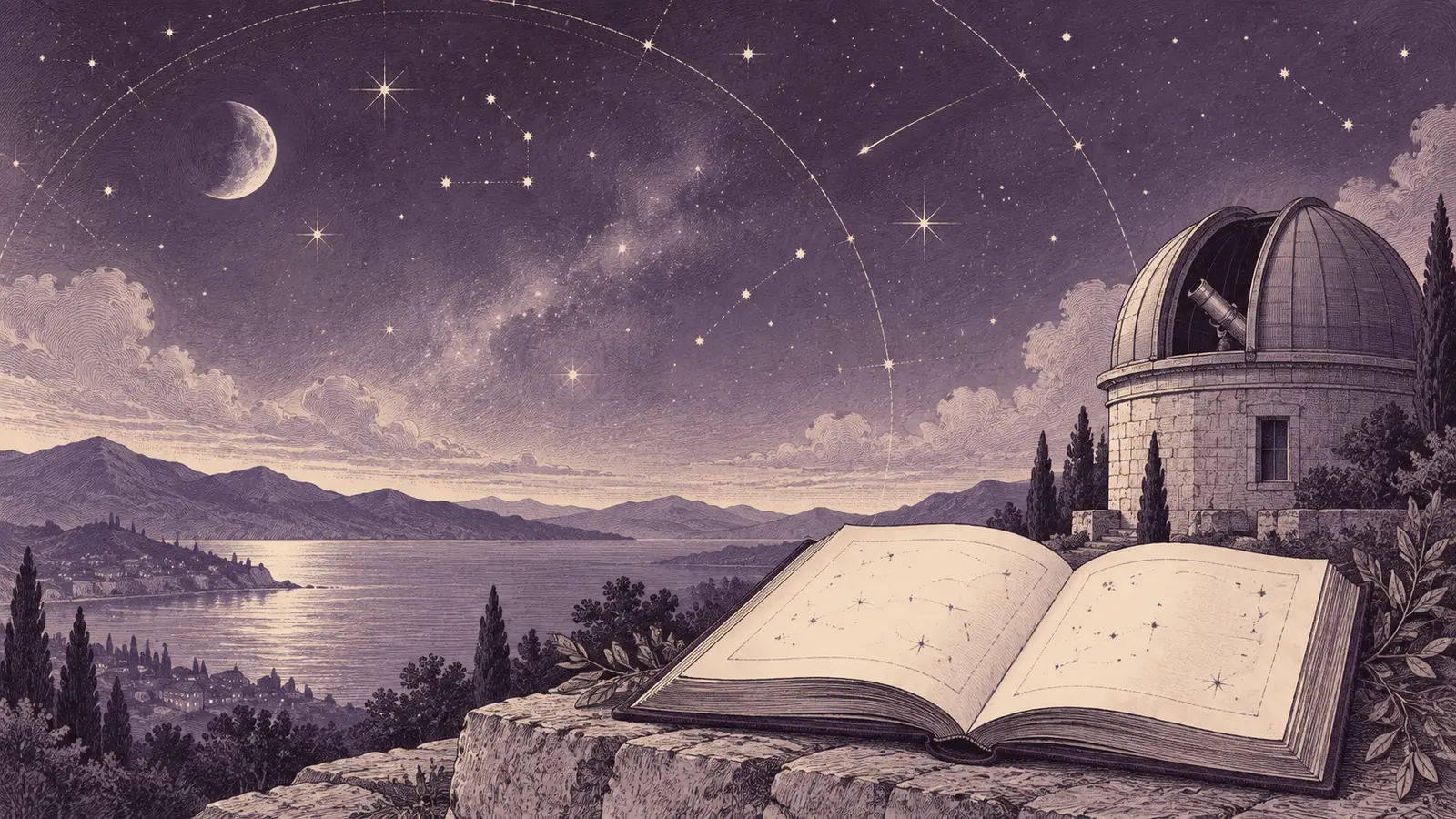
Make twelve cards for this exercise, marking each with a zodiac symbol of your choice. Instead of assigning them personality traits or predictions, give them twelve writing tasks. They can help you decide what a character sees, wants, understands, or leaves behind. This is a creative exercise: no card reveals who a person is or what will happen to them. The page remains open to your choices, including choices that change as your story takes shape.
Before starting the story, clarify what the actual sky can tell you. Stars that seem to make a shape may lie at very different distances from Earth; they are not necessarily connected to one another. Astronomers now use 88 officially recognized constellations as regions of the sky. Which constellations you can see also depends on your location and the time of year. An imagined shape and an astronomical region therefore serve different purposes, even when a familiar name invites both kinds of attention.
For the first four cards, try four questions: What image opens the story? Where does the scene take place? Who speaks? What does that person want? You might invent a traveler who looks at the stars and imagines a closed door. The traveler writes a letter to someone back home. The door belongs to the fiction, and so do the traveler and the letter. The cards invite you to choose details; they do not claim that those details can be discovered among the stars.
Give the next four cards the tasks of introducing an obstacle, an assumption, a check, and a revision. The traveler might think the drawing of a door points toward a direction. Then the traveler examines what was actually seen: bright points and a shape added by imagination. The letter changes to distinguish the two. Where can your character recognize an invented image? Which assumption deserves another look? These are questions for writing, not effects attributed to the sky or instructions received from it.
The final four cards can invite a memory, another perspective, a choice, and an ending. The traveler remembers the person who will receive the letter. You can then briefly tell the scene from that person’s point of view before deciding whether the traveler sends it. Finally, find a last sentence. Remembering a person, choosing an action, and finding words are separate acts here. Each can alter the draft because you decide what belongs in the story.
Now reread the piece as someone who has never seen your cards. Does the imagined door help explain what the traveler wants? Does the letter make the choice understandable? If a sentence presents the shape as an object literally fastened between stars, would you keep it as a poetic image or rewrite it? This reading does not ask you to abandon the symbol. It invites you to make clear what kind of statement each sentence is making.
If you also want to look at the sky, make that a separate activity from the fiction. NASA says you can begin skywatching without special equipment, and an app can help you learn what to seek at a given place, date, and time. To see more faint stars, move away from bright city lights and choose a place where you feel safe. You can then note what you actually recognize, without expecting your invented scene to appear overhead.
The distinction also matters when the word zodiac brings astrology to mind. Astronomy studies outer space using evidence and data. Astrology rests on the belief that the positions of certain celestial objects can predict the future or describe a person; its claims are not based on scientific evidence. A symbol can hold cultural meaning or offer entertainment and writing material. That use does not turn it into a scientific method of prediction, and a fictional traveler need not treat it as one.
Together, the twelve cards made for this exercise have supplied decisions for one story: image, place, voice, desire, obstacle, assumption, check, revision, memory, another viewpoint, choice, and ending. You are free to shuffle them for a new draft. Which image would you keep as fiction? What could you check if you were describing the real sky? Those questions are invitations to write and observe carefully, while leaving the decisions on the page to you.
Astrology is entertainment and an invitation to reflect. It does not predict events or replace professional advice.